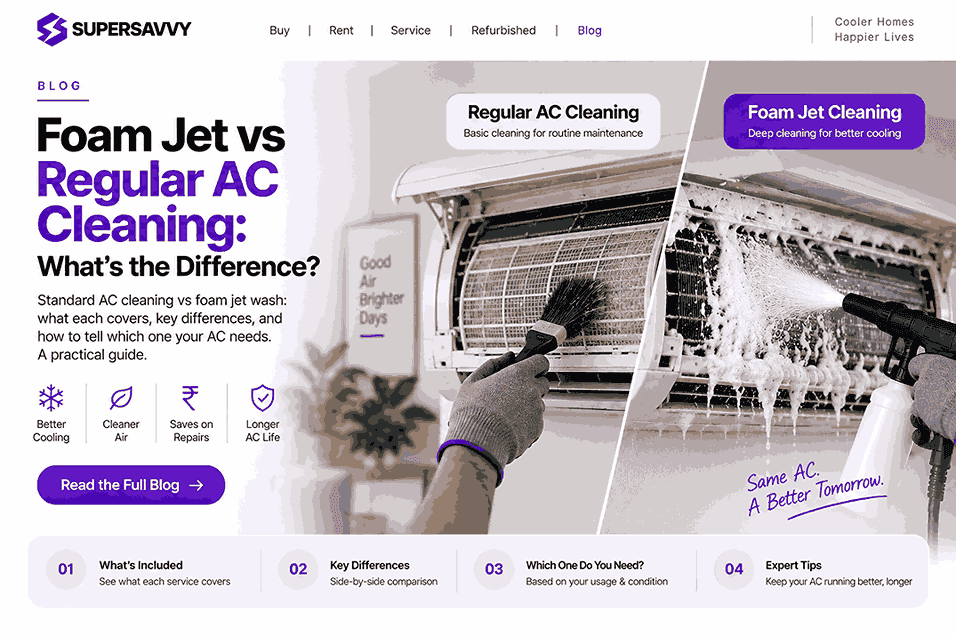
When you book an AC cleaning, you’ll usually see two options: a regular (dry/standard) clean and a foam jet wash. They sound similar, but they cover very different levels of work. Choosing the wrong one means either paying more than you need to, or not actually solving the problem. Here’s a clear breakdown of what each involves, how they differ, and how to decide which one your AC actually needs.
What a regular AC cleaning covers
A regular cleaning is the maintenance step that happens during a routine AC service visit. It’s designed to keep the unit running efficiently between deeper cleans. Here’s what it typically includes:
Filter cleaning. The indoor unit’s dust filters are removed, washed with water and dried before being refitted. This is the single biggest airflow improvement in any service.
Dry-brush coil cleaning. The technician uses a soft brush to remove loose dust from the evaporator coil fins. No water or chemicals are applied to the coils.
Outdoor unit check. The condenser coil is brushed and debris around the outdoor unit is cleared.
Drain line flush. The condensation drain is cleared to prevent water backup.
A regular clean is quick — the cleaning portion takes roughly 15 to 20 minutes as part of a full service visit that runs 30 to 60 minutes in total. It handles surface-level dust and keeps airflow healthy.
What a foam jet wash involves
A foam jet wash (also called an AC jet service, deep clean, or wet service) is a dedicated, more intensive cleaning process. It goes beyond what a brush can reach. Here’s what happens:
Partial disassembly. The indoor unit’s front panel and housing are removed to fully expose the evaporator coil. This is necessary to apply water and cleaning agents directly.
Chemical foam application. A specialised AC coil cleaner (foam-based) is sprayed onto the evaporator coil. The foam penetrates between the fins and dissolves grease, mould, algae and biological buildup that a dry brush cannot reach.
High-pressure water rinse. After the foam has soaked (usually 10 to 15 minutes), a controlled jet of water flushes the dissolved grime off the coil and into the drain tray. The water pressure is calibrated for AC coils — strong enough to clean, but not so strong that it bends the delicate fins.
Condenser coil wash. The outdoor unit’s condenser is also jet-washed to remove caked-on dust and grime that reduces heat rejection.
Drain system flush. The entire drainage path — tray, pipe and outlet — is flushed clean.
Drying and reassembly. The unit is dried, reassembled and tested. Drying is important — turning the AC on with wet components can cause issues.
A foam jet wash typically takes 60 to 90 minutes per unit. It is a standalone service, not part of a routine visit.
Key differences at a glance
Here’s how the two compare on the points that matter most:
Cleaning method: Regular uses a dry brush on coil surfaces. Foam jet uses chemical foam plus a pressurised water rinse that reaches deep between the fins.
What it removes: Regular handles loose, surface dust. Foam jet removes stubborn grease, mould, algae and hardened grime that builds up over months.
Time: Regular cleaning takes 15–20 minutes (within a service visit). Foam jet takes 60–90 minutes as a dedicated job.
Frequency: Regular cleaning should happen at every service visit (every 3–6 months of heavy use). A foam jet is typically needed once a year, or when the AC shows signs of heavy soiling.
Cost: Regular cleaning is usually included in a standard AC service. A foam jet wash is a separate service with its own charges because of the additional time, chemicals and equipment involved.
Disassembly: Regular cleaning needs minimal disassembly (just the filter panel). Foam jet requires the front housing to be removed and a waterproof setup to protect the wall and floor.
How to tell which one your AC needs
You don’t need technical knowledge to judge this. Look for these signs:
A regular clean is enough when:
Your AC was serviced within the last 3–4 months and is cooling normally.
The filters are dusty but the coils behind them look relatively clean.
There’s no unusual smell when the AC runs.
You use the AC moderately (not running 12+ hours daily).
You probably need a foam jet wash when:
It’s been more than a year since the coils were deep-cleaned.
The AC produces a stale or musty smell — this usually means mould or algae on the evaporator.
You can see visible grime or dark discolouration on the coil fins (look behind the filters).
Cooling has dropped noticeably even though gas pressure is fine — dirty coils reduce heat transfer.
The AC is leaking water indoors because the drain is persistently clogging with biological debris.
Your home is in a high-dust or high-humidity area (coastal cities, construction zones, ground-floor units near roads).
If you’re unsure, a technician can tell you within a minute of opening the indoor panel whether a regular clean will do or whether the coils need a jet wash.
Can you clean AC coils yourself?
You can handle the basics at home — cleaning your AC filters and coil surfaces with a soft brush and mild soap is straightforward and worth doing between service visits. But a foam jet wash is not a DIY job. It requires a coil-safe chemical cleaner (household detergents can corrode aluminium fins), controlled water pressure, a waterproof sheet setup to catch runoff, and proper drying before reassembly. Getting any of these wrong risks damaging the coil or causing an electrical fault. This is one of the jobs that genuinely needs a trained technician.
What about “Blue Coat” or other branded cleaning services?
Some providers offer branded cleaning tiers (e.g. “Blue Coat”, “Silver Clean”, “Gold Clean”). These are marketing names for different service levels, usually varying in the type of chemical used, the number of components cleaned, or whether the outdoor unit is included. The core process is the same — chemical foam, jet rinse, dry. When comparing options, focus on what is actually included (indoor coil, outdoor coil, drain, filter) rather than the brand name of the service tier.
How Supersavvy handles AC cleaning
Supersavvy offers both standard AC cleaning (as part of a regular service) and dedicated foam jet wash services through in-house, trained technicians. The process follows a structured checklist, and pricing is shared transparently before work begins so there are no surprises. Repairs or issues discovered during the cleaning carry a 90-day warranty, subject to the applicable terms.
To schedule an AC cleaning in Mumbai or any of Supersavvy’s service cities, you can book online and a technician will be assigned to your visit.
Frequently asked questions
Is foam jet cleaning safe for my AC?Yes, when done by a trained technician using coil-safe chemicals and calibrated water pressure. The risk comes from using household cleaners (which can corrode fins) or excessive pressure (which can bend them). Professional-grade foam cleaners are pH-balanced for aluminium and copper coils.
How often should I get a foam jet wash?Once a year is a good baseline for most households. If you run the AC heavily (12+ hours daily through summer), live in a high-dust or coastal area, or notice smell or reduced cooling, you may need it every 6–8 months.
Does a jet wash include gas top-up?No. A jet wash is a cleaning service. If the technician finds low gas pressure during the post-clean performance check, a gas top-up or refill is a separate service with its own charges.
Can I just get a jet wash without a full service?Yes. A foam jet wash can be booked as a standalone cleaning job. However, most technicians will also check the basics (filter, drain, gas pressure) as part of the visit because the unit is already open.