AC Gas Refill Cost by Tonnage: What You’ll Actually Pay
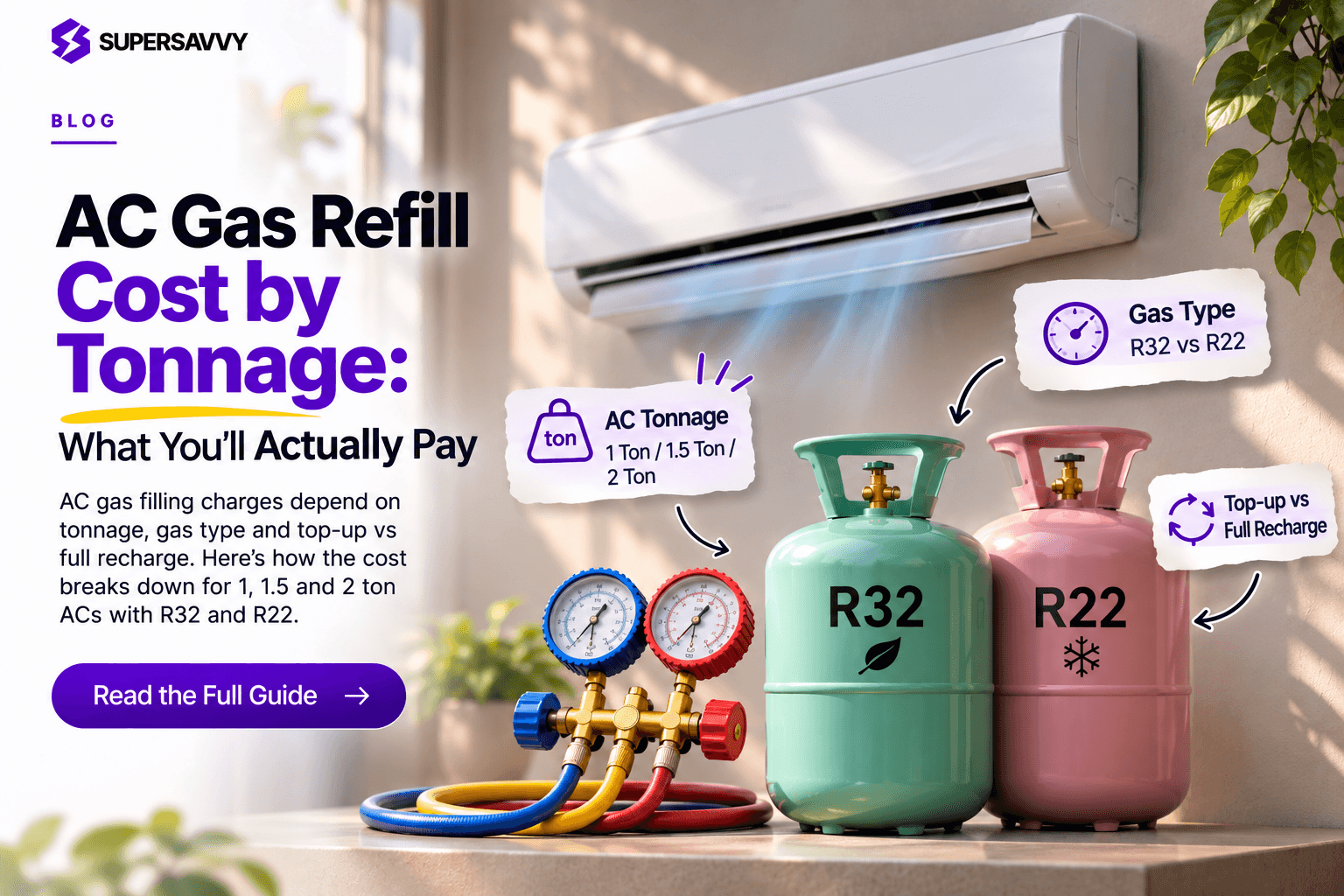
When your AC stops cooling properly and a technician says it needs gas, the first question is usually “how much will it cost?” The answer depends on three things: your AC’s tonnage, the type of refrigerant it uses, and whether you need a top-up or a full recharge. Here’s how ac gas filling charges break down so you know what to expect before the technician arrives.
Why tonnage affects the cost
Your AC’s tonnage (1 ton, 1.5 ton, 2 ton) determines how much refrigerant the system holds. A larger AC needs more gas, which costs more. The relationship is roughly linear:
1 ton split AC: holds approximately 600–900 grams of refrigerant.
1.5 ton split AC: holds approximately 900–1,200 grams.
2 ton split AC: holds approximately 1,200–1,500 grams.
These are typical ranges — the exact charge weight is printed on a label on the outdoor unit (look for “refrigerant charge” or “gas charge” in grams or kg). Window ACs typically hold less gas than split ACs of the same tonnage because the refrigerant lines are shorter.
R32 vs R22: the gas type matters
The type of refrigerant your AC uses significantly affects the cost:
R32 — used in most ACs manufactured after 2018–2020. It’s more energy-efficient, has a lower global warming potential, and is currently the standard for new split ACs in India. R32 is generally more affordable per kg than R22.
R22 (Freon) — used in older ACs (pre-2018 and some models up to 2020). R22 is being phased out globally under the Montreal Protocol, which means supply is shrinking and prices are rising. If your AC runs on R22, gas filling costs more than R32, and the gap will only widen.
R410A — used in some inverter ACs. Pricing is generally between R32 and R22.
You cannot mix refrigerant types. Your AC is designed for one specific gas (marked on the outdoor unit label), and using the wrong type damages the compressor.
Full recharge vs top-up
This is the biggest cost variable after tonnage and gas type:
Top-up: Adding a small amount of gas to bring the system back to its correct pressure. This is appropriate when the AC has lost a small amount of gas gradually over years (a minor, slow leak or natural permeation). Costs less because less gas is used.
Full recharge: Recovering whatever gas remains, vacuuming the system, and charging the full specified amount from scratch. This is needed after a major leak, after a repair where the system was opened (like replacing the compressor or a pipe section), or after AC shifting. Costs more because you’re paying for the complete gas charge plus the vacuum and recovery process.
A reliable technician will check the system pressure before deciding between a top-up and a full recharge — not default to a full recharge every time. If your AC has a confirmed gas leak, the leak must be found and repaired before recharging, otherwise the new gas will escape too.
What affects the final price
AC gas filling charges depend on several factors beyond just tonnage:
Tonnage — higher tonnage = more gas = higher cost.
Refrigerant type — R22 costs more than R32 due to phase-out scarcity.
Full recharge vs top-up — a full charge uses more gas and requires vacuum work.
Leak repair — if a leak is found, the repair (brazing, joint tightening, coil repair) is an additional charge on top of the gas itself.
Service provider — pricing varies between providers. Some charge per gram, others charge a flat rate per tonnage slab. Ask for the breakdown before agreeing.
At Supersavvy, gas charging starts from ₹899 (indicative — the final cost depends on tonnage, gas type and the specific work involved). Pricing is shared transparently before the work begins.
When does your AC need gas?
A common misconception is that AC gas “runs out” like petrol and needs periodic refilling. In a sealed, leak-free system, the same refrigerant can last the entire life of the AC (10–15 years). Gas only needs to be refilled when:
There’s a leak. A leak at a flare joint, a corroded coil, or a damaged copper pipe causes gradual gas loss. Signs include reduced cooling, ice forming on the indoor coil, and hissing sounds near the refrigerant lines.
After a repair that opened the system. Replacing the compressor, condenser coil or a pipe section requires recovering the gas, doing the repair, vacuuming and then recharging.
After AC shifting. If the pump-down during uninstallation wasn’t done properly, gas escapes and a recharge is needed at the new location.
Gradual permeation loss. Over many years (7–10+), a very small amount of gas can permeate through joints. This is normal but rare — most ACs never need a top-up if there’s no actual leak.
If a technician says your relatively new AC (2–4 years old) needs gas, ask them to check for a leak first. Topping up gas without finding the leak is a temporary fix that wastes money.
How to check if your AC is low on gas
You can’t measure refrigerant level at home, but these signs suggest low gas:
The AC runs but doesn’t cool the room properly even after cleaning the filters.
Ice forms on the copper pipe (the thinner pipe) coming out of the indoor unit.
The outdoor unit’s compressor runs for a few minutes and then shuts off (low-pressure cutoff).
You hear a faint hissing near the pipe connections (active leak).
A technician confirms low gas by checking the system pressure with a manifold gauge. The pressure reading, combined with the ambient temperature, tells them exactly how much gas the system is short by.
How Supersavvy can help
Supersavvy’s in-house technicians handle AC gas filling for all major AC brands and both R32 and R22 systems. The process includes a pressure check, leak inspection (if gas loss is suspected), and a transparent quote before any gas is charged. Gas charging starts from ₹899 (indicative). Repairs carry a 90-day warranty, subject to the applicable terms.
To schedule a gas recharge in Mumbai or any of Supersavvy’s service cities, you can book online.
Frequently asked questions
How often does AC gas need to be refilled?In a leak-free system, never. The refrigerant circulates in a sealed loop and doesn’t get “used up.” Gas needs refilling only when there’s a leak, after a repair that opened the system, or after improper AC shifting. If your AC needs gas every year, it has a leak that should be repaired — not just topped up.
Is R22 gas still available?Yes, but supply is decreasing due to the global phase-out. R22 is still available in India, but prices are rising year over year. If your AC uses R22 and the compressor fails, it may be more economical to replace the AC with a newer R32 model rather than invest in an expensive R22 compressor replacement.
Can I get my R22 AC converted to R32?No. The two gases operate at different pressures and require different compressors, expansion valves and sometimes even different copper pipe diameters. Converting is not safe or practical — the AC must be designed for the specific refrigerant from the factory.
Why does one technician say I need gas and another says I don’t?Because some technicians default to “low gas” as a diagnosis without actually checking the pressure. A proper diagnosis involves connecting a manifold gauge to the service port and reading the pressure. Ask the technician to show you the reading — a good technician will explain what the numbers mean.