AC repair service
AC Not Turning On? Quick Checks Before You Call a Technician
Your AC won't start? Run through these quick checks — power supply, remote, timer, filters, error codes — before calling a technician. A practical troubleshooting guide.
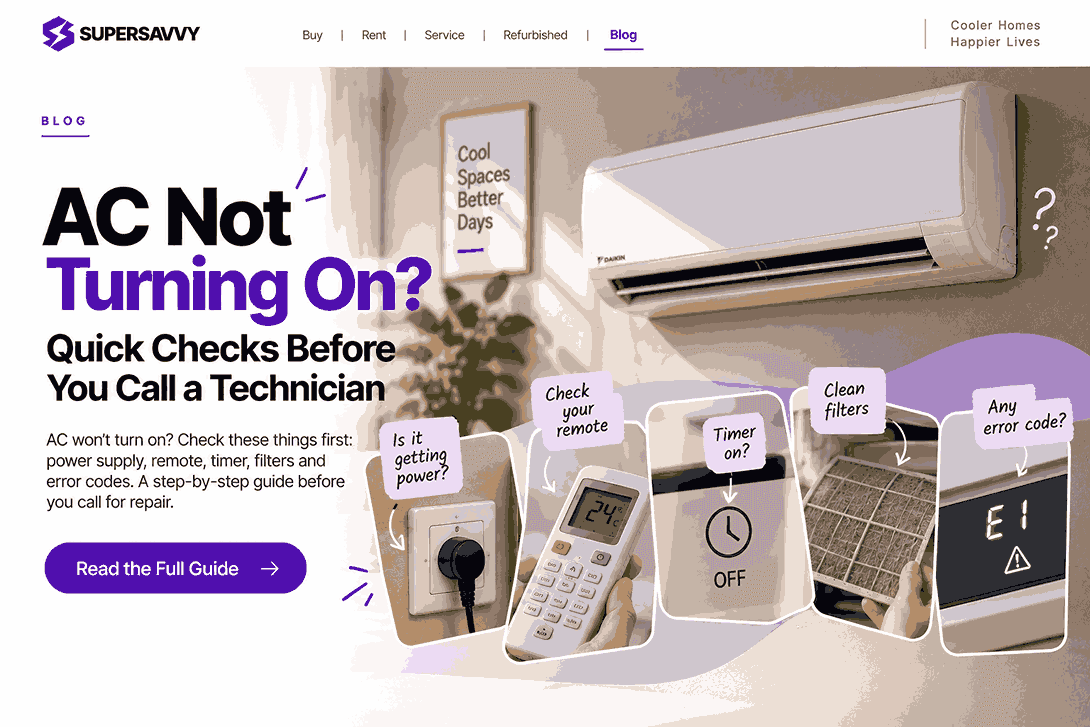
AC Not Turning On? Quick Checks Before You Call a Technician
You press the power button and nothing happens — no beep, no display, no airflow. An AC that won’t turn on is frustrating, but it doesn’t always mean something expensive is broken. Before you book a repair visit, run through these checks. Several of them take less than a minute and can save you both time and a service call.
1. Check your power supply
This is the most common reason an AC won’t start, and the easiest to miss.
MCB / circuit breaker. Open your electrical panel and check whether the MCB (miniature circuit breaker) for the AC circuit has tripped. A tripped MCB sits in the middle position or flipped down. Reset it by pushing it fully off and then back on. If it trips again immediately, stop — there may be a short circuit, and you need an electrician or AC technician.
Power socket. Plug something else (a phone charger, a lamp) into the same socket. If that device doesn’t work either, the socket is dead — check the MCB or try a different socket.
Plug connection. Make sure the AC’s power plug is fully inserted. A loose plug can cut power without being obvious. For split ACs with a hardwired connection (no plug), check the isolator switch near the outdoor unit.
Voltage. In areas with frequent voltage fluctuations, many ACs have built-in voltage protection that prevents the compressor from starting when voltage is too low or too high. The AC may show an error code or simply refuse to turn on. If your area has unstable power, a stabiliser is worth considering.
2. Check the remote control
If the AC has power (the indicator light on the indoor unit is on) but doesn’t respond to the remote:
Replace the batteries. Weak batteries are the single most common “AC not working” false alarm. Even if the remote display shows something, the IR signal can be too weak to reach the unit.
Test the IR signal. Point the remote at your phone camera and press any button. You should see a faint purple/white flash through the camera. No flash means the remote is faulty.
Try the manual button. Most split AC indoor units have a small power button (sometimes behind a flip panel on the right side). Press it. If the AC starts, the problem is the remote, not the AC.
Clear the line of sight. IR remotes need a direct path to the receiver on the indoor unit. Curtains, furniture or a dusty receiver panel can block the signal.
3. Check the timer and mode settings
Modern ACs have timer, sleep and auto-off functions that can prevent the unit from starting when you expect it to.
Timer. If a timer was set previously (even accidentally), the AC may be waiting for the scheduled time. Cancel any active timer on the remote.
Mode. If the AC is set to “Fan Only” mode at a low speed, it might seem like it’s not running. Switch to “Cool” mode and set the temperature to 20–22°C to test.
Auto-restart delay. After a power cut, most ACs wait 3–5 minutes before restarting the compressor (to protect it from short-cycling). If your power just came back, wait a few minutes before assuming the AC is faulty.
4. Check the filters
Some AC models have a safety feature that prevents the unit from running when the filters are extremely clogged. This is more common in premium models with filter-status indicators.
Open the front panel of the indoor unit and slide out the filters.
If they’re heavily caked with dust, wash them under running water, let them dry completely, and refit them.
Try turning the AC on again.
Even if this isn’t the cause, cleaning the filters is never wasted effort — clogged filters reduce cooling and increase electricity consumption.
5. Check for error codes
If the AC’s display or indicator LEDs are blinking in a pattern (rather than showing a normal temperature), it’s likely showing an error code. Check the user manual or search for your AC model + the blinking pattern online. Common error codes point to:
Sensor faults (indoor or outdoor temperature sensor)
Communication errors between the indoor and outdoor units
Compressor protection triggered (overheating, overcurrent)
Refrigerant pressure issues
If you see an error code, note it down before calling a technician — it helps them diagnose faster and arrive with the right parts.
When you need a technician
If none of the checks above fix the problem, the issue is likely electrical or mechanical — and needs professional diagnosis. Common causes that require a technician include:
Faulty capacitor. The capacitor provides the initial jolt of electricity to start the compressor and fan motors. A failed capacitor is one of the most common reasons a split AC won’t start. The outdoor unit may hum briefly and then shut off.
Compressor failure. If the compressor itself has failed (seized, burnt winding), the AC cannot cool. This is a more serious repair.
PCB (control board) fault. The indoor unit’s PCB controls everything — the remote signal, fan speed, temperature regulation, error reporting. A damaged PCB can prevent the AC from responding at all.
Wiring or connection issue. Loose or corroded wiring between the indoor and outdoor units, or at the terminal block, can cause intermittent or complete failure to start.
Refrigerant leak. A significant refrigerant leak can trigger the AC’s low-pressure safety switch, preventing it from starting to protect the compressor.
What about ACs that turn on but don’t cool?
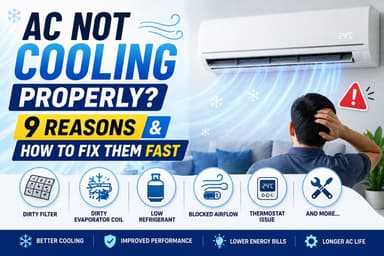
That’s a different problem. If your AC powers on, the fan runs, but the air isn’t cold, the issue is usually related to gas levels, dirty coils or a compressor running at reduced capacity. See why your AC might not be cooling properly for a separate walkthrough of those causes.
How Supersavvy can help
If you’ve tried the checks above and the AC still won’t turn on, Supersavvy’s in-house technicians can diagnose and repair the problem. An AC inspection starts from ₹149 (indicative — the final cost depends on the issue found). The aim is to arrange a technician visit within approximately one hour of booking where operationally possible, and pricing for any repair is shared transparently before the work begins. Repairs carry a 90-day warranty, subject to the applicable terms.
To book an AC repair in Mumbai or any of Supersavvy’s service cities, you can schedule online.
Frequently asked questions
Why does my AC turn off by itself after a few minutes?This is usually a compressor protection feature triggered by overheating, overcurrent or a refrigerant issue. The AC starts, runs briefly, then shuts down to protect the compressor. A technician can read the error code and identify the specific cause.
My AC’s outdoor unit is not starting but the indoor fan works. Why?The most likely cause is a failed capacitor in the outdoor unit, or a communication error between the indoor and outdoor units. The indoor fan runs on its own motor and can work even when the outdoor unit is off. This needs a technician.
Can a power surge damage my AC?Yes. A voltage spike can damage the PCB, capacitor or compressor winding. If your AC stopped working after a power fluctuation or lightning, these components should be checked. A voltage stabiliser helps prevent this.
Is it safe to keep trying to turn on an AC that won’t start?If the MCB trips repeatedly when you try, stop immediately — there may be a short circuit. Otherwise, it’s generally safe to try a few times after checking the basics (power, remote, timer). But if the outdoor unit hums and shuts off, avoid repeated attempts as this can stress the compressor.
Need an AC Today?
Buy refurbished, pre-owned, or second-hand ACs at the best rates in Mumbai.
✅ Free installation support
✅ Instant buyback available
📞 Call/WhatsApp: +91 7098110110




Navigation links
HomeAbout UsMy BookingsBlogsContact UsRaise a ComplaintComplaintsPartner AppTechnical AcademySupport ChatAll Rights Reserved ©
