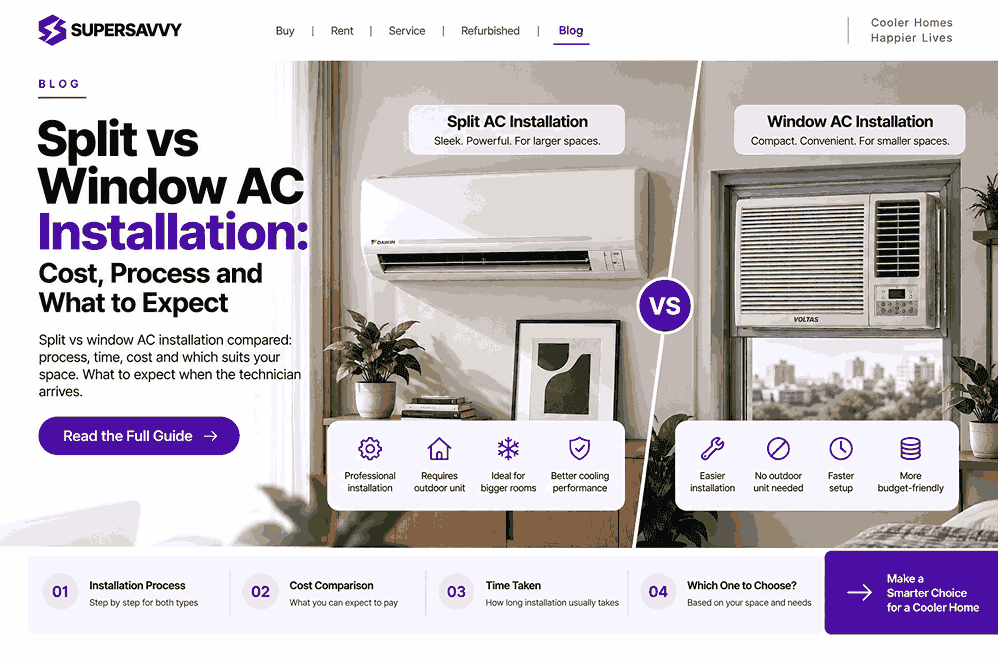
Getting an AC installed isn’t just about choosing a brand or tonnage — the type of unit you pick (split or window) determines exactly how the AC installation works, what it costs, and what structural changes your room might need. If you’re deciding between a split and a window AC, or if you already have one and want to understand what the installation process involves before the technician arrives, here’s a practical comparison.
How window AC installation works
A window AC is a single self-contained unit — the compressor, condenser, evaporator and fan are all inside one box. Installation is simpler because there’s only one component to mount.
What the process involves
Window or wall opening. The unit sits in a window frame or a purpose-cut wall opening. If you’re using an existing window, the technician fits a support frame or bracket. If the window is larger than the unit, the gap is sealed with a filler panel (usually sheet metal or plywood).
Mounting and levelling. The AC must tilt very slightly outward so condensation drains outside, not into the room. The technician secures the unit on its bracket and checks the tilt.
Sealing. Gaps between the unit and the frame are sealed with rubber gaskets or foam to prevent outside air, rain and insects from getting in.
Electrical connection. A dedicated power socket (usually 15A or 16A) is needed nearby. If one doesn’t exist, the technician or an electrician will install one.
Test run. The unit is switched on and checked for cooling output, vibration and drainage.
Typical time
30 to 60 minutes for a straightforward installation (window already has an opening). Longer if a wall opening needs to be cut.
How split AC installation works
A split AC has two separate units — an indoor unit (evaporator and fan) and an outdoor unit (compressor and condenser) — connected by copper piping and electrical cables. Installation is more involved.
What the process involves
Indoor unit mounting. A metal bracket (mounting plate) is fixed to the wall, usually at a height of 7–8 feet. The wall must be strong enough to hold the weight (typically 8–12 kg for the indoor unit). The technician drills the bracket holes and a separate hole through the wall for the connecting pipes.
Outdoor unit placement. The compressor unit (25–50 kg depending on tonnage) is placed on a wall-mounted bracket, a ground-level platform, or a balcony floor. It needs good airflow around it and should be protected from direct rain where possible.
Copper piping and insulation. Two insulated copper pipes (liquid line and suction line) connect the indoor and outdoor units. The technician measures, cuts and flares the pipes, then connects them with flare nuts. The pipe run is insulated to prevent condensation and energy loss. Pipe length depends on the distance between units — usually 3 to 5 metres for a standard installation.
Drain pipe. A separate PVC pipe runs from the indoor unit to an outside drain point. This carries away the condensation that forms during cooling.
Electrical wiring. The indoor and outdoor units are connected with inter-unit cabling. A dedicated power point (usually 16A) is required. The technician checks that the MCB (circuit breaker) in the electrical panel is rated correctly.
Vacuuming the lines. Before gas is released, the technician connects a vacuum pump to the piping to remove moisture and air. This step is critical — moisture in the refrigerant loop causes poor cooling and compressor wear. A proper vacuum usually takes 15 to 20 minutes.
Gas release and test run. Most new split ACs come pre-charged with refrigerant (R32 or R410A). The technician releases the gas from the outdoor unit into the piped system and runs the AC to check cooling output, pipe insulation, drainage and noise levels.
Typical time
2 to 3 hours for a standard split AC installation. Add more time if the pipe run is long, the outdoor unit is on a high floor, or wall drilling is difficult (concrete vs brick).
Key differences between split and window AC installation
Number of components: Window AC is one unit; split AC has two units connected by piping.
Wall work: Window AC needs a window opening or wall cutout. Split AC needs drill holes for piping and a bracket for the indoor unit — but no large opening.
Installation time: Window takes 30–60 minutes. Split takes 2–3 hours.
Tools and skills required: Window AC installation is simpler and sometimes done by the buyer. Split AC installation requires specialised tools (pipe flaring kit, vacuum pump, pressure gauges) and should always be done by a trained technician.
Portability: A window AC can be uninstalled and moved relatively easily. A split AC is more permanent because of the piping, brackets and wall drilling.
Noise: With a split AC, the compressor sits outside, so the indoor unit runs quietly. A window AC has the compressor inside the room.
Cooling performance: Split ACs generally cool more efficiently and evenly for the same tonnage, partly because the outdoor unit isn’t dumping heat into the room.
What does AC installation cost?
AC installation charges depend on the type of unit, pipe length, bracket type, floor height and whether any additional electrical work is needed.
Window AC installation is usually simpler and cheaper — the main costs are the bracket/frame, sealing materials and labour.
Split AC installation costs more because of the copper piping, insulation, brackets for both units, vacuum pump work and longer labour time.
At Supersavvy, AC installation starts from ₹1,200 (indicative — the final cost depends on the unit type, pipe length, bracket requirements and any additional work). Pricing is shared transparently before the work begins.
If you’re installing a second-hand or refurbished AC, the installation process is the same, but the technician will also check the unit’s condition, gas level and electrical connections before completing the setup.
Which type is right for your space?
The best choice depends on your room, building and budget:
Choose a window AC if: your room has a suitable window opening or you’re in a rented flat where you can’t make permanent wall changes; you want a lower upfront cost; you may need to move the AC later; or the room is small (up to ~150 sq ft).
Choose a split AC if: you want quieter operation indoors; your room doesn’t have a suitable window; you need to cool a larger space; energy efficiency matters (inverter split ACs are generally more efficient); or the building allows outdoor unit mounting.
For a more detailed walkthrough of the full installation process, including what to prepare before the technician arrives, see the AC installation guide for Mumbai.
How Supersavvy handles AC installation
Supersavvy uses in-house, trained technicians for both split and window AC installations. The process includes a pre-installation site check (pipe run, bracket placement, electrical readiness), standard-length copper piping and insulation, vacuum pump testing, and a post-installation performance check. Pricing is shared before the work starts, and the aim is to arrange a technician visit within approximately one hour of booking where operationally possible.
To book an AC installation in Mumbai or any of Supersavvy’s service cities, you can schedule online.
Frequently asked questions
Can I install a window AC myself?It’s technically possible if you have a suitable window frame and basic tools, but getting the tilt, sealing and electrical connection right matters. A poorly installed window AC can vibrate excessively, leak water indoors, or draw rain and insects. Professional installation is more reliable and usually inexpensive.
Can I install a split AC myself?No. Split AC installation requires pipe flaring, brazing, vacuum pump operation and refrigerant handling. These need specialised tools and training. Incorrect installation can cause gas leaks, poor cooling, compressor failure and even electrical hazards. Always use a trained technician.
How much copper pipe does a split AC need?A standard installation uses 3 to 5 metres of pipe. The exact length depends on the distance between the indoor and outdoor units. Extra pipe length is usually charged separately.
Does the price include the bracket?This varies by provider. At Supersavvy, the quote shared before installation covers the standard components needed. Ask specifically about bracket costs when you book.
What if I need to move my AC later?A window AC is easier to uninstall and move. A split AC requires an uninstallation process (gas recovery, pipe disconnection, bracket removal) and then reinstallation at the new location. Both services are available at Supersavvy.